Duplicate content
By BeeRanked · September 28, 2026
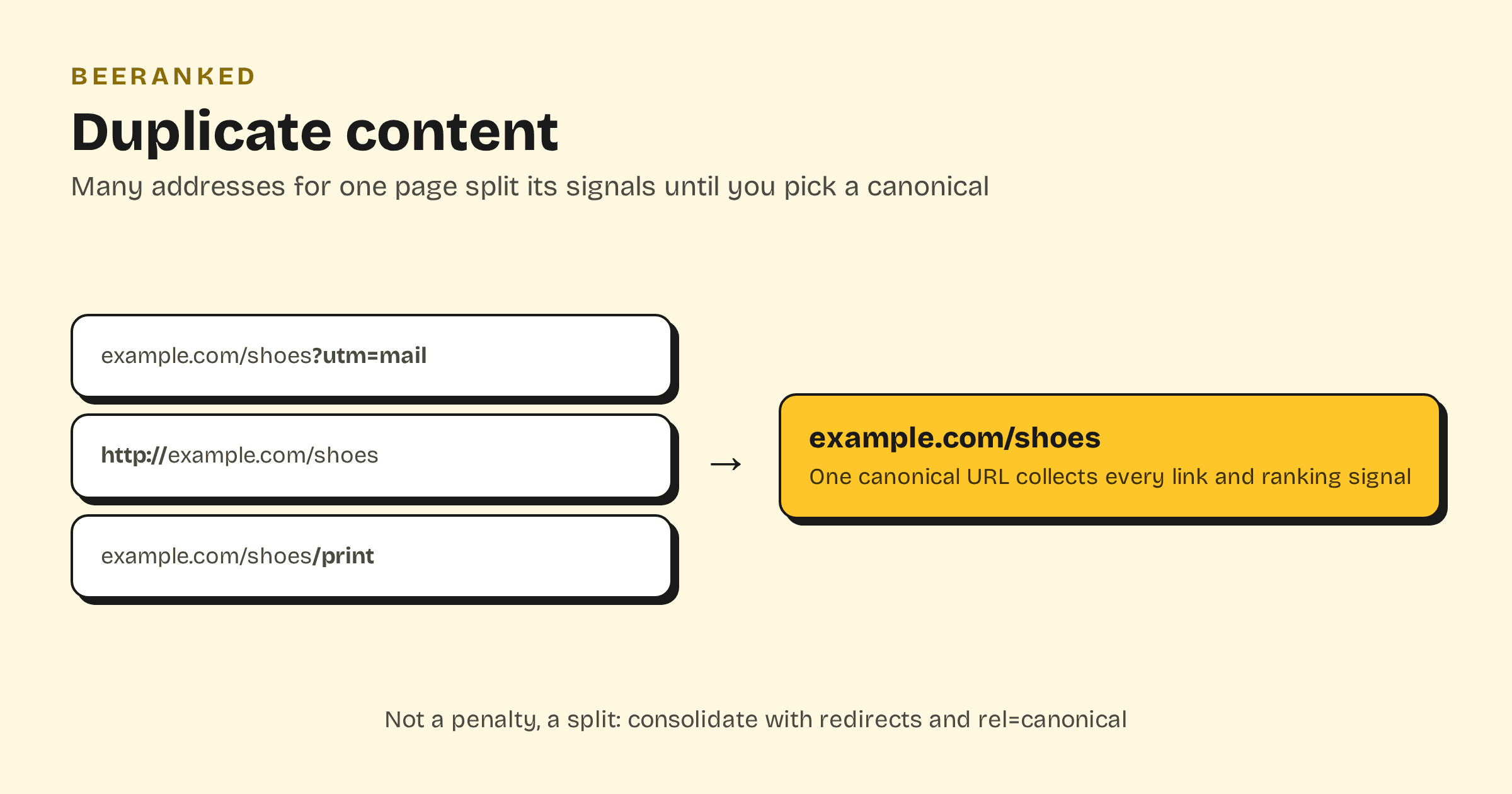
Duplicate content is the same page, or a nearly identical one, reachable at more than one URL: with and without tracking parameters, on http and https, with a print version, or republished under two paths.
What duplicates cost
For ordinary sites there is no duplicate content penalty; Google handles duplicates algorithmically by picking one version, and says most sites "will likely do just fine" without doing anything. What duplicates cost is focus: links and ranking signals scatter across the variants until Google consolidates them onto one canonical URL. Canonicalization exists, in Google's words, to "consolidate the signals they have for the individual URLs (such as links to them) into a single, preferred URL". Left unmanaged, Google's pick may not be the version you wanted.
How to consolidate
Google lists the signals in order of strength, and notes they stack:
A redirect is the strongest: the duplicate stops existing as a separate page. Use a 301 redirect when the variant has no reason to stay reachable.
A canonical annotation (
rel="canonical") is a strong hint that keeps the variant reachable but tells search engines which URL to rank.Sitemap inclusion is a weak signal: list only your canonical URLs in the XML sitemap.
Duplicate pages that are separate on purpose but target the same query are a different problem, keyword cannibalization, and want a merge instead of a canonical.
Duplicates in BeeRanked
Every BeeRanked page ships a self-referencing canonical tag automatically, one clean URL per page, and the sitemap lists only those canonical URLs. Translated pages canonicalize themselves, so multilingual sites do not trip over this either.